
If you’re not passing CancellationToken everywhere in your
async code, you are silently leaking resources and ignoring user
cancellations. Here’s exactly why it matters and how to fix it.
In many ASP.NET Core projects,
async/await is everywhere, but
CancellationToken is either ignored or sprinkled in only at
the controller level. On paper the app “works”, requests return responses,
and everyone moves on.
Then real traffic hits.
Suddenly you see memory creeping up during load tests, database connections staying busy even after clients disconnect, background jobs that refuse to stop during deployments, and threads mysteriously “stuck” in long-running operations.
Most of the time, the root cause is simple: cancellation is not wired end-to-end.
Let us understand what actually happens in real systems when you do (and
don’t) use CancellationToken, how thread-jumping changes the
way you think about work, why static helpers can quietly destroy your
app’s behavior, and how to design your code so that cancellations are
respected without turning everything into a mess.
1. From Sync to Async: Why Cancellation Suddenly Matters
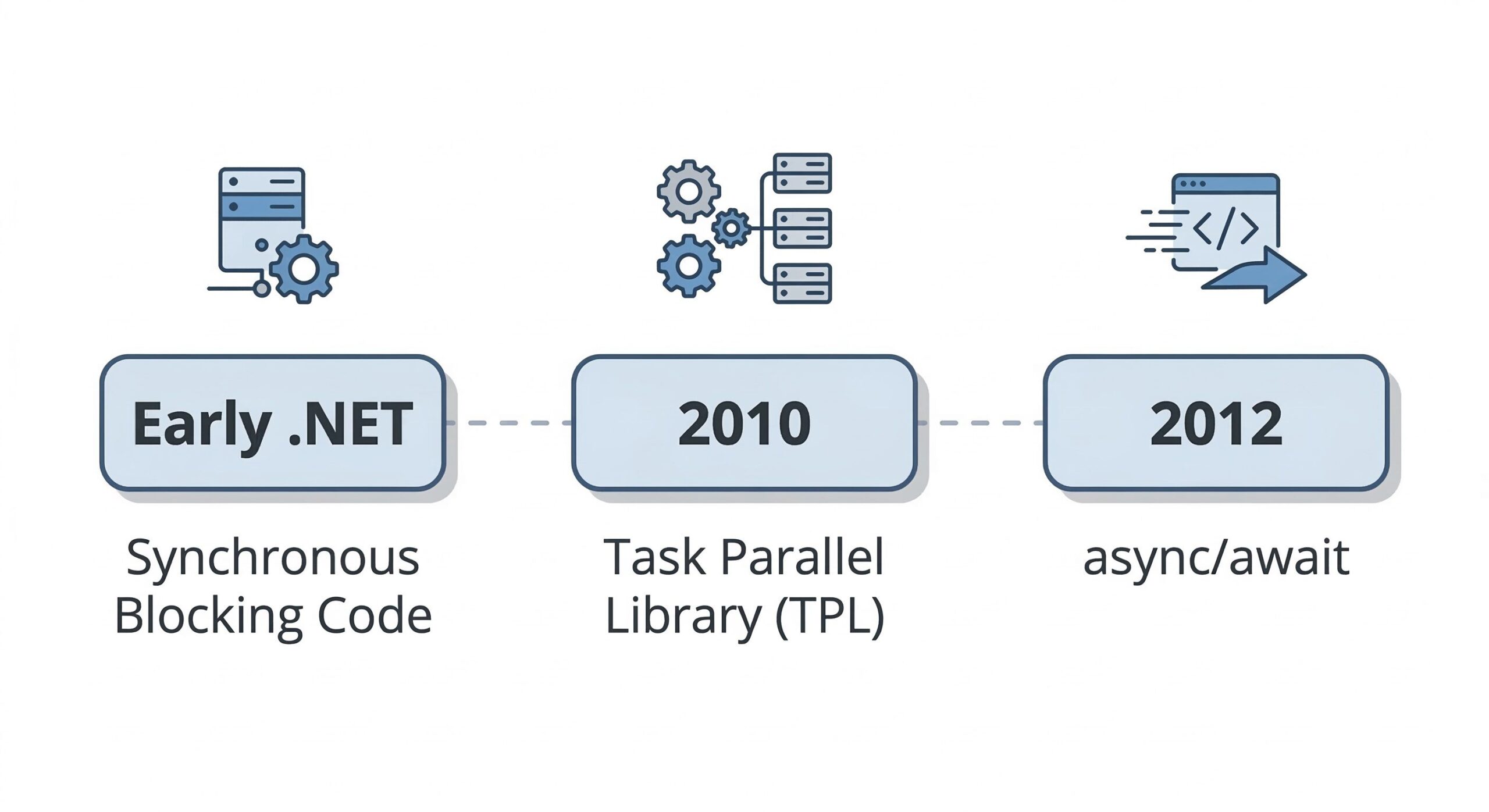
In the early .NET days, everything was synchronous. A request came in, a
thread handled it, the thread blocked on I/O, and you waited. It was
simple to reason about but terrible for scalability.
Then came:
-
Task Parallel Library (TPL) – giving us
Taskand parallelism primitives -
async/await– letting us write non-blocking code that looks synchronous
This solved the “one thread per request” scalability bottleneck, but it also introduced a new dimension: operations can now outlive the original call stack and jump threads.
When you await something:
- The current thread is freed to do other work
- The continuation may resume on a completely different thread
- That continuation can keep doing work even when the user has already gone away
This is where cancellation becomes critical. Without it, your app keeps doing expensive work for nobody:
- Database queries keep running
- External HTTP calls continue
- CPU-heavy loops keep chewing resources
In small demo apps, this is invisible. In real-world systems with spikes (sale events, seasonal peaks, background batch loads), it leads to wasted capacity, worse throughput, and unpredictable behavior.
Bottom line: async made scalability possible, but only cooperative cancellation makes it sustainable.
2. Demystifying CancellationToken and
CancellationTokenSource
Let us first clarify the basic building blocks. Many misunderstandings come from mixing up roles and lifetimes.
2.1 Two Key Concepts
-
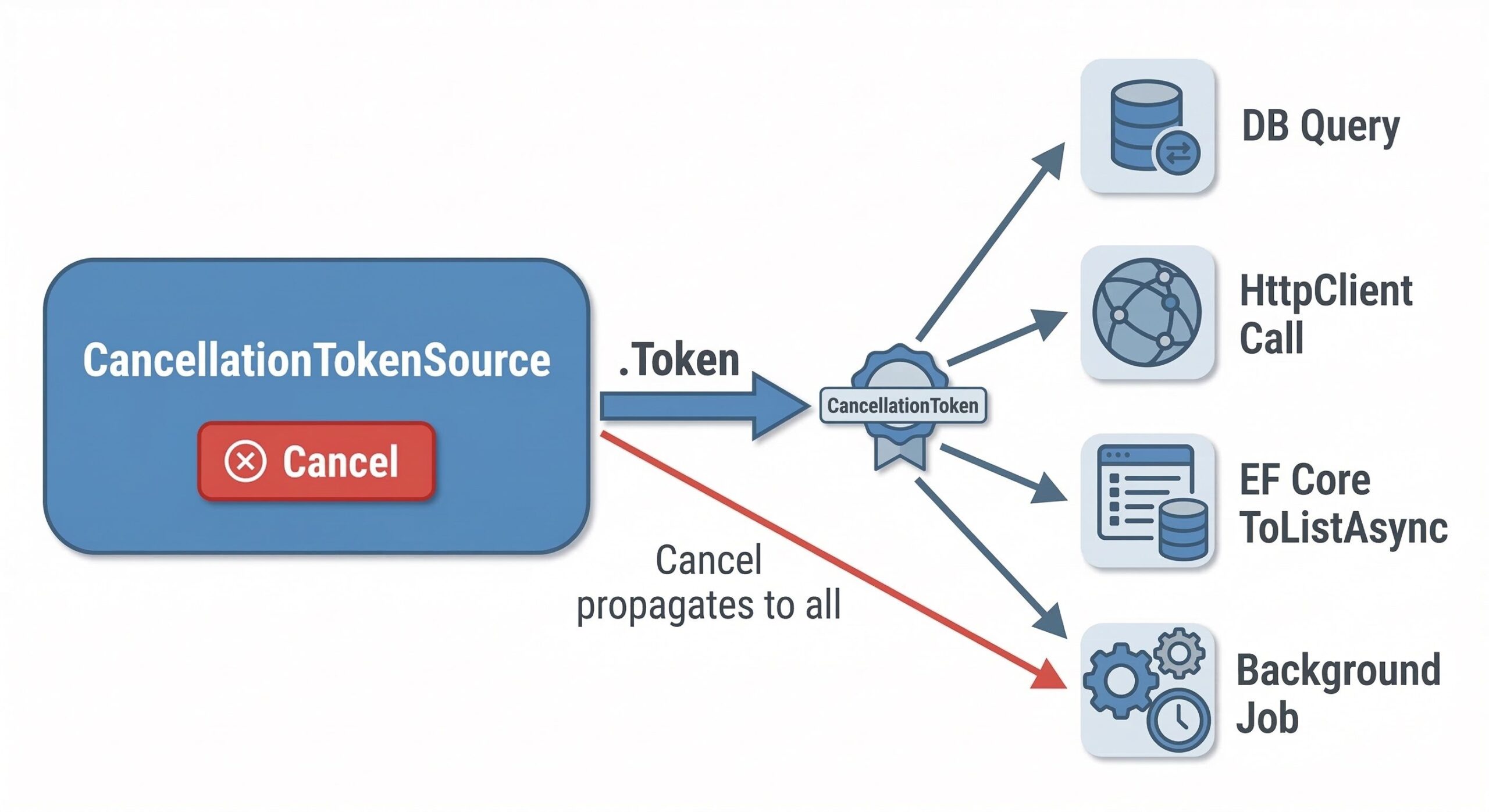
CancellationTokenSource(CTS) – the control panel or the “cancel switch”. - It is mutable, disposable, and
triggers cancellation for one or more tokens via
Cancel(). -
CancellationToken(CT) – the immutable signal that flows through your app. - It is lightweight and can be passed around freely.
-
It exposes
IsCancellationRequestedand is used by APIs to respond to cancellation.
A CTS creates a token and owns its lifetime. The token just carries the signal.
2.2 Lifecycle: Request, Not Force
Cancellation in .NET is cooperative, not forced.
-
Calling
cts.Cancel()does not magically kill the thread. - It sets a flag and wakes any waits that listen to that token.
- Your code (and frameworks like EF Core, HttpClient, etc.) must check the token and react by throwing or stopping work.
For example:
CancellationTokenSource cts = new CancellationTokenSource();

// Somewhere later in the code
cts.Cancel(); // Triggers cancel for all tokens created from this source

// Token obtained from the source
CancellationToken token = cts.Token;

if (token.IsCancellationRequested)
{
    // Application decides how to respond
    // e.g., cleanup and exit early
}

cts.Dispose(); // Always dispose to free resources (timers, registrations, etc.)
Key points:
-
cts.Cancel(): Signals all operations usingcts.Token. -
token.IsCancellationRequested: Your hook to react. -
cts.Dispose(): Critical in long-running apps to avoid resource leaks.
If you use timeouts (e.g., CancelAfter), the CTS may
internally allocate timers or registrations. Forgetting to dispose
long-lived CTS instances is a quiet leak.
2.3 Linked Tokens: Building Hierarchies
In ASP.NET Core, each HTTP request already has a token (the “request token”), which fires when:
- The client disconnects
- The server aborts the request
Most of your custom cancellations should link to this token instead of creating your own isolated world:
CancellationTokenSource linkedCts =
    CancellationTokenSource.CreateLinkedTokenSource(
        httpContext.RequestAborted,
        businessTimeoutToken);

CancellationToken linkedToken = linkedCts.Token;
When any of the upstream tokens cancel, the linked token reacts. This is how you avoid doing work after:
- The client closed the browser tab
- Your business timeout expired
- The server is shutting down
Section 3: The Thread‑Jumping Reality – Why You MUST Pass
CancellationToken
This is where many developers make a critical mistake. Let us understand
what actually happens when you await an async operation
without wiring cancellation all the way down.
When you write this:
public async Task<IActionResult> Search(string query, CancellationToken cancellationToken)
{
    SearchResult result = await _service.SearchAsync(query, cancellationToken);
    return Ok(result);
}
What actually happens internally?
- ASP.NET Core starts processing the request on a thread from the thread pool.
-
You call
_service.SearchAsyncandawaitit. - The current thread is released back to the pool—it can now serve other requests.
- When the I/O completes (say, the database query returns), the continuation resumes on some thread, which may be completely different from the one that started the operation.
This thread‑jumping is by design—it’s what gives async its scalability.
But here’s the hidden danger: if you stop passing the
CancellationToken at any point in the call chain, everything
below that point becomes deaf to cancellation.
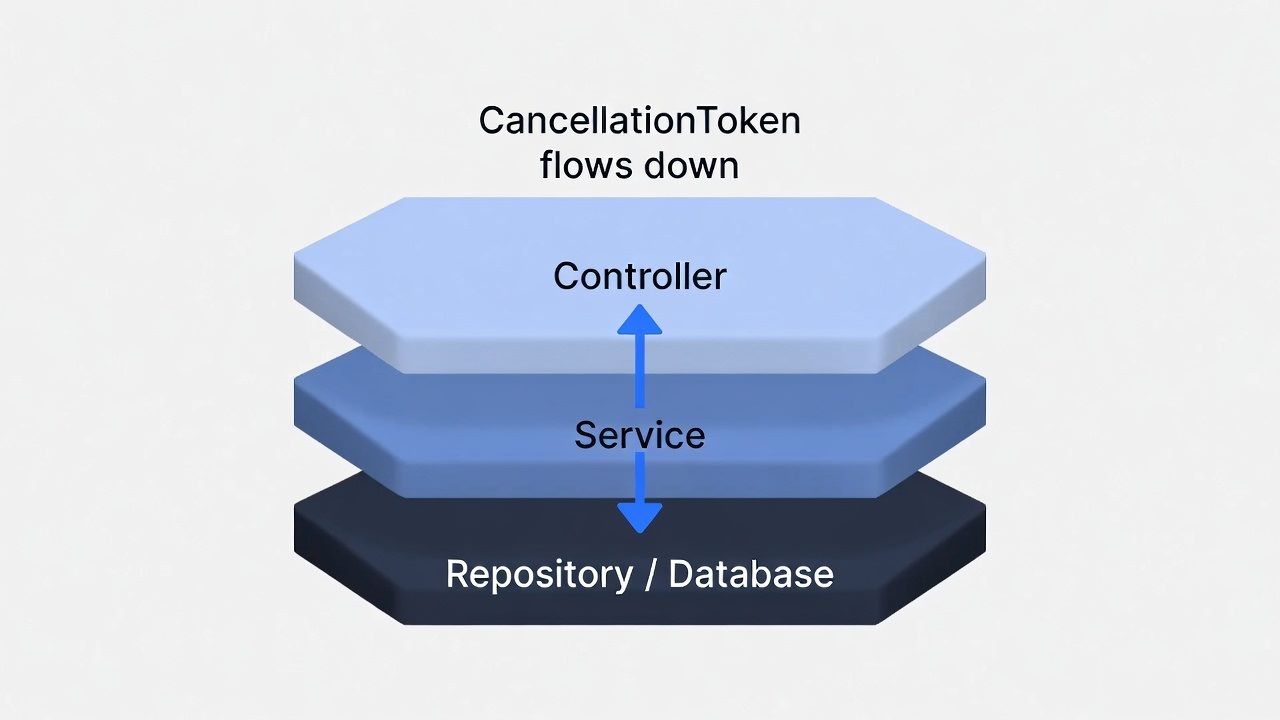
Picture a typical three‑layer flow:
- Controller: has the token.
- Service: receives it but forgets to pass it to the repository.
-
Repository: calls
ToListAsync()with no token.
Now imagine a real‑world e‑commerce search:
- User searches “wireless headphones”
- That triggers DB queries, cache lookups, external catalog requests
- The user closes the browser tab 200ms later
If your repository and external calls are not wired to receive the token, they will keep running—long after the user has disconnected:
- The database query churns away, holding a connection.
- The external HTTP call continues, occupying a socket.
- Memory and CPU are burned for a result nobody will ever see.
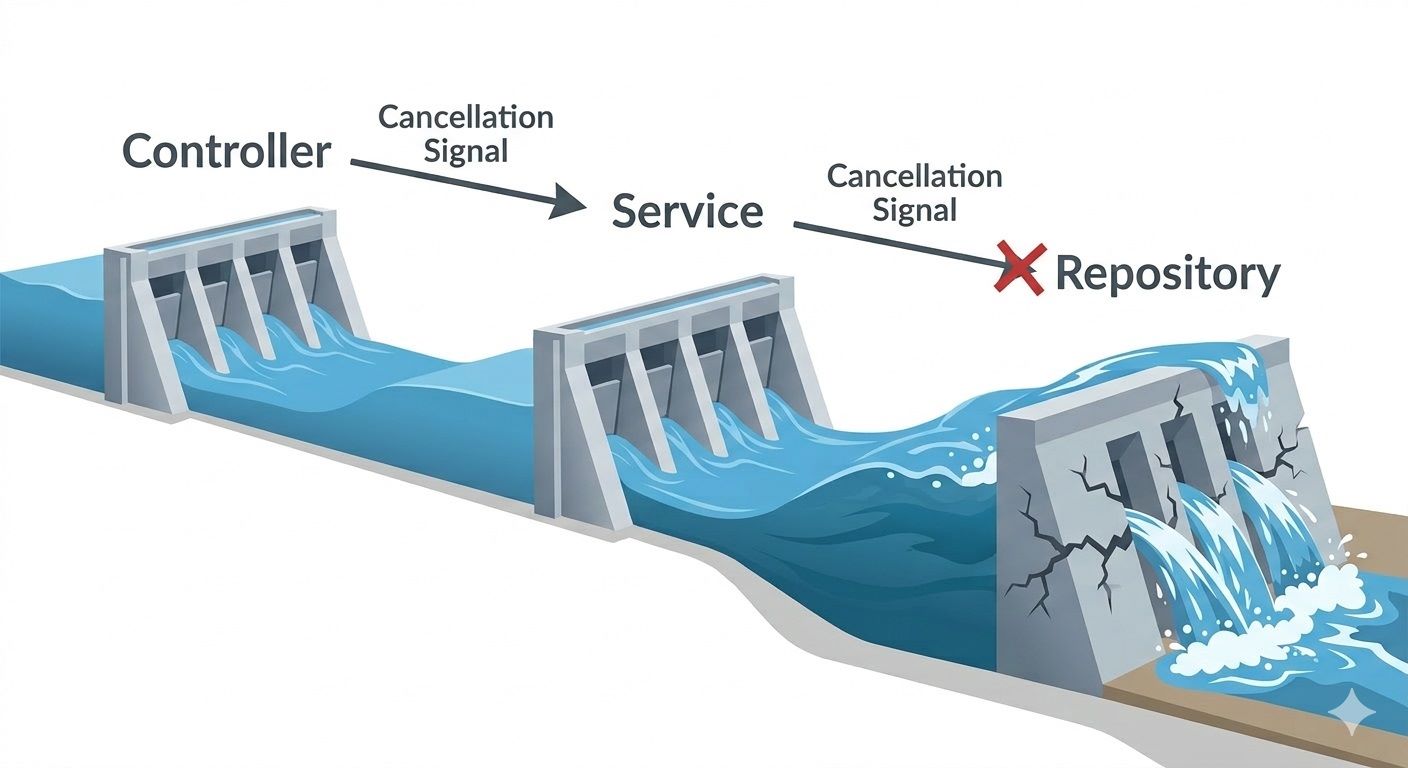
From a practical point of view, this is like having a flood‑control system with a chain of three dams.
-
Dam 1 (Controller layer) gets the flood warning—the
client disconnect triggers
RequestAborted. It opens its gates (cancels its own work) and sends the alert downstream. - Dam 2 (Service layer) is wired correctly. It receives the alert, opens its gates, and relays the signal.
-
Dam 3 (Repository layer) was built without an alarm
connection. The developers forgot to pass the
CancellationTokento the database query. The alert never arrives.
Now the water rushes down from the opened dams—but Dam 3’s gates stay shut. Pressure builds, the dam fails, and the valley floods.
In your application, that flood takes the form of:
- Database connection pool exhaustion—connections held open by queries that should have been cancelled.
- Memory pressure—state machines and other objects pinned in memory because tasks never complete.
- Thread pool starvation—threads blocked waiting for I/O that will never finish, preventing new requests from being processed.
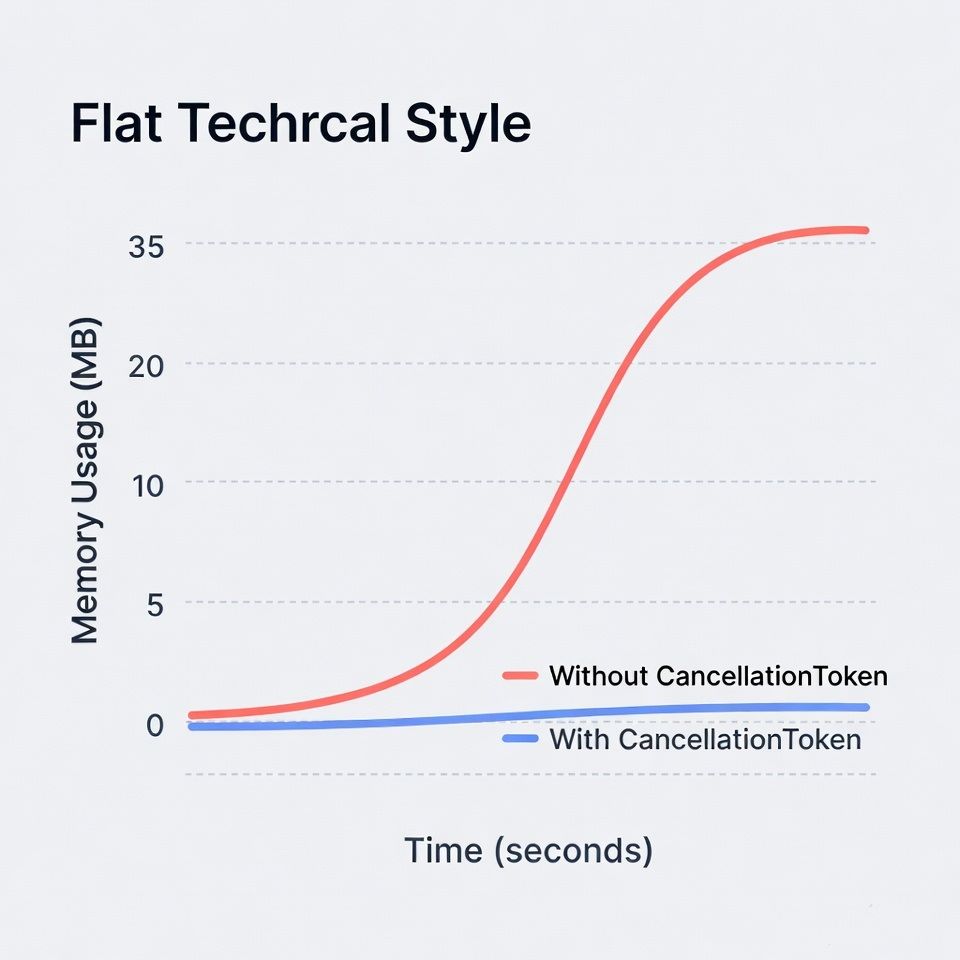
In real load tests, simply ensuring the
CancellationToken flows all the way to the deepest I/O call
often yields a 20% throughput improvement and a dramatic
flattening of memory usage. The fix is simple: pass the token. Every time.
4. Improving Responsiveness and UX: Timeouts and Graceful Degradation
From a practical point of view, cancellation is not just about protecting servers; it is also about better user experience.
4.1 Client Timeouts Propagating to the Server
Modern front-ends use mechanisms like AbortController (in
JavaScript) or mobile HTTP client timeouts. When the client gives up,
ASP.NET Core’s
HttpContext.RequestAborted token fires.
If you propagate this token:
- Long search queries stop mid-way instead of running to completion.
- File uploads stop reading the body as soon as the client cancels.
- External service calls get cancelled, freeing threads and sockets.
If you do not propagate it, your server is busy “finishing” work that nobody will see.
4.2 Global Timeouts via Middleware
ASP.NET Core also supports global timeouts
(e.g., via middleware or RequestTimeoutOptions). From a
practical design standpoint:
- Set a reasonable timeout for your API (e.g., 2–5 seconds for typical queries).
- When the timeout hits, the middleware cancels the token.
- Your business logic, if wired properly, respects that cancellation and stops further work.
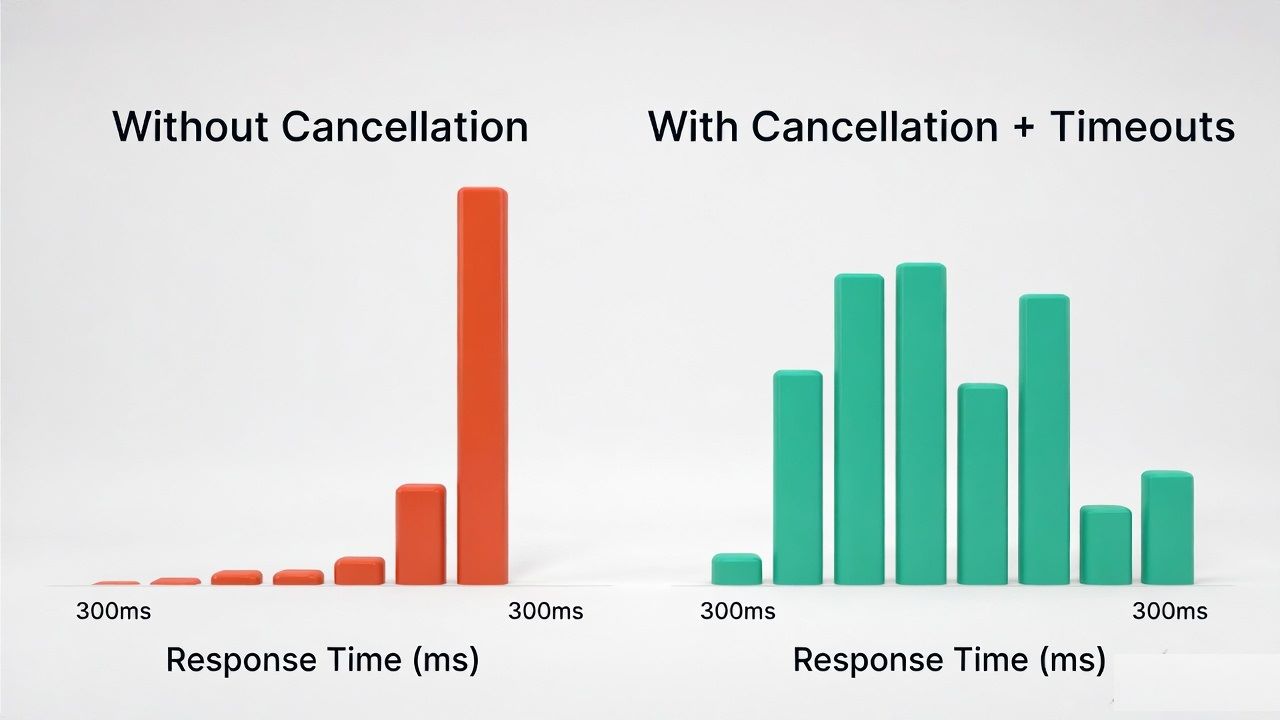
This is graceful degradation: instead of every layer timing out individually in different ways, you have a single coordinated cancellation signal your code cooperates with.
5. Wiring It Up in ASP.NET Core: From Controller to Repository
This is where many developers make mistakes:
CancellationToken appears in controller signatures but
mysteriously disappears in deeper layers.
// Startup
services.AddHttpContextAccessor();
Let us walk through a practical wiring pattern.
5.1 Controller: Take the Token Explicitly
ASP.NET Core can bind the request token directly to an action parameter:
[HttpGet("search")]
public async Task<IActionResult> Search([FromQuery] string query, CancellationToken cancellationToken)
{
    SearchResult result =
        await _searchService.SearchAsync(query, cancellationToken).ConfigureAwait(false);

    return Ok(result);
}
- The
cancellationTokencomes from the hosting layer. - You do not create a new CTS unless you need additional logic (e.g., shorter timeout).
5.2 Service Layer: Accept and Pass Forward
Your service should not invent its own token; it should accept one:
public async Task<SearchResult> SearchAsync(string query, CancellationToken cancellationToken)
{
    List<Product> products =
        await _productRepository.SearchProductsAsync(query, cancellationToken).ConfigureAwait(false);

    ExternalData recommendations =
        await _recommendationClient.GetRecommendationsAsync(query, cancellationToken)
                                   .ConfigureAwait(false);

    return new SearchResult(products, recommendations);
}
Every dependency that can possibly do I/O receives the same
cancellationToken. That is the “wire” that carries
cancellation through your architecture.
5.3 Repository: EF Core with Cancellation
EF Core supports cancellation tokens in all async queries:
public async Task<List<Product>> SearchProductsAsync(string query, CancellationToken cancellationToken)
{
    List<Product> products =
        await _dbContext.Products
                        .Where(p => p.Name.Contains(query))
                        .ToListAsync(cancellationToken)
                        .ConfigureAwait(false);

    return products;
}
If the client disconnects or a timeout triggers, the query is cooperatively cancelled, and EF Core frees resources earlier instead of waiting for the DB to finish everything.
5.4 HttpClient: External Calls with Cancellation
When using IHttpClientFactory:
public async Task<ExternalData> GetRecommendationsAsync(string query, CancellationToken cancellationToken)
{
    HttpClient client = _httpClientFactory.CreateClient("Recommendations");

    HttpResponseMessage response =
        await client.GetAsync($"/recommendations?q={query}", cancellationToken).ConfigureAwait(false);

    response.EnsureSuccessStatusCode();

    string content = await response.Content.ReadAsStringAsync(cancellationToken).ConfigureAwait(false);

    ExternalData data = JsonSerializer.Deserialize<ExternalData>(content)!;

    return data;
}
Notice every async operation that supports a token gets the
same cancellationToken.
6. Real-World Use Cases: Where Cancellation Really Pays Off
In real-world projects, cancellation is not a theoretical concern; it is central to some very common scenarios.
6.1 Search APIs and Dashboards
- Users type quickly and change filters frequently.
- Old requests become irrelevant before they even finish.
If you cancel outdated searches:
- The server does not waste time computing results the user will never see.
- Throughput improves because you are only doing current work.
6.2 File Uploads and Streaming
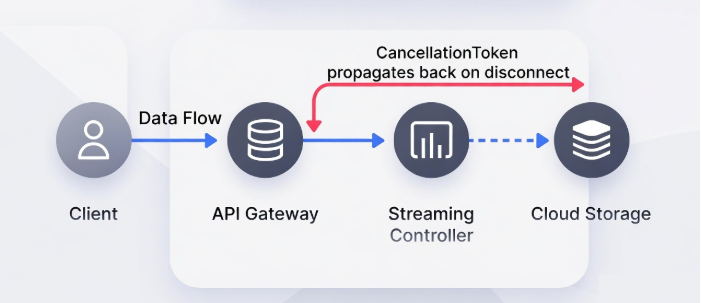
For streaming APIs (file uploads, video streaming, chunked responses):
- The client may lose connectivity, navigate away, or close the app.
- Without cancellation, your server may continue reading/writing bytes.
Checking RequestAborted or passing the token into streaming
loops prevents:
- Large buffers sitting in memory
- Worker threads blocked on pointless I/O
6.3 Background Jobs and Graceful Shutdown
Background services (e.g., IHostedService, worker services)
receive a CancellationToken during shutdown. If you ignore
it:
- Deployments are slow because the host waits for tasks that never stop.
- Jobs may be cut mid-way when the host finally kills the process.
Respecting cancellation allows:
- Graceful termination of batch jobs
- Safe rollbacks with explicit checkpoints
7. Best Practices: Polling, Throwing, and Cleanup
Now let us talk about how to implement cancellation in a robust, idiomatic way.
7.1 Periodic Checks in Loops
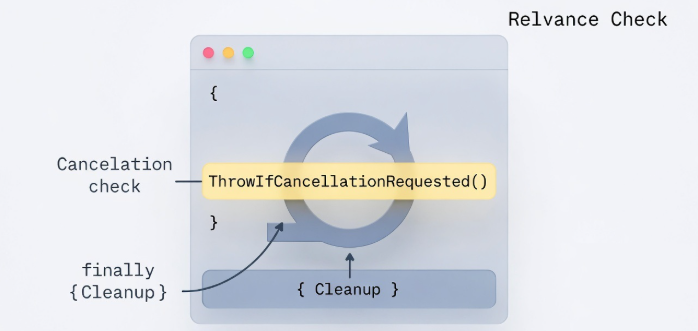
For CPU-bound or long-running loops, you should periodically check the token:
public void ProcessItems(IEnumerable<Item> items, CancellationToken cancellationToken)
{
    foreach (Item item in items)
    {
        cancellationToken.ThrowIfCancellationRequested();

        // Process the item
        ProcessItem(item);
    }
}
ThrowIfCancellationRequested() is a convenient way to:
- Honor cancellation
- Bubble up
OperationCanceledException - Allow the caller (or ASP.NET Core) to understand this is expected, not a bug
7.2 Always Cleanup in finally
Cancellation often means you exit work earlier than usual. If this is not handled properly, resources might remain allocated.
public async Task ProcessOrderAsync(Guid orderId,CancellationToken cancellationToken)
{
    ResourceHandle handle = AcquireResource(orderId);

    try
    {
        await _paymentGateway.ChargeAsync(orderId, cancellationToken).ConfigureAwait(false);

        await _inventoryService.ReserveStockAsync(orderId, cancellationToken).ConfigureAwait(false);
    }
    finally
    {
        // This runs even when cancellation occurs
        handle.Dispose();
    }
}
-
The
finallyblock runs even when cancellation triggers. - This is where you should release resources, return items to pools, and close connections.
8. Pitfalls and Anti-Patterns: How Static Classes Will Destroy Your App
This is where the title’s warning becomes concrete. Static helpers are
convenient, but they often hide state and
lifetime problems that interact badly with
CancellationToken.
8.1 Static CancellationTokenSource
One of the worst patterns I have seen in production is:
public static class CancellationManager
{
    public static CancellationTokenSource GlobalCts = new CancellationTokenSource();
}
And then various parts of the app using
CancellationManager.GlobalCts.Token.
Problems:
- Global CTS is never disposed → potential resource leak.
-
One component calling
GlobalCts.Cancel()can accidentally cancel unrelated operations across your entire app. - It breaks the natural “per request” and “per operation” lifetimes, making debugging cancellation behavior extremely painful.
In real incidents, this kind of pattern has caused:
-
Entire batches to stop because some unrelated module triggered
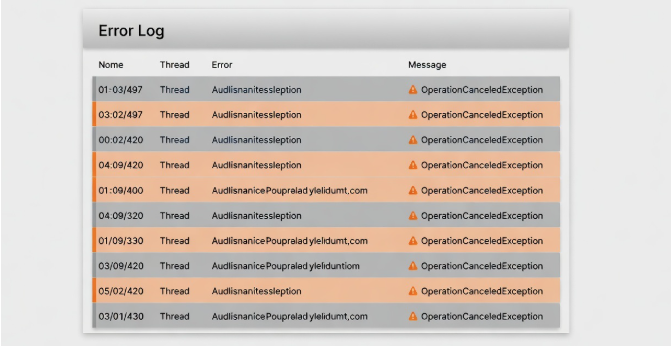
Cancel() - APIs randomly returning
OperationCanceledException - Difficult-to-reproduce bugs tied to race conditions around when the global token was cancelled and reset
Moreover, when you register a callback on a token (e.g., by passing it to
Task.Delay or using token.Register()), the
CancellationTokenSource creates a
CallbackNode and appends it to an internal linked list. If
the source is static, that linked list grows forever, causing a
silent memory leak because the source holds references to
all those callbacks, preventing GC collection.
8.2 Static Service Facades That Ignore Tokens
Another common anti-pattern:
public static class SearchFacade
{
    public static Task<SearchResult> SearchAsync(string query)
    {
        // No CancellationToken parameter
        return _searchService.SearchAsync(query, CancellationToken.None);
    }
}
This seems harmless but:
- You have closed the door for cancellation at higher levels.
- Any caller using this static facade cannot propagate the request token.
Over time, these static utilities accumulate, creating dead-ends where cancellation can no longer flow.
8.3 Thread-Safety and Hidden Mutable State
Statics often mix:
- Mutable state (e.g., caches, CTS, configuration)
- Missing synchronization
- Ad-hoc “reset” behavior for tokens
Combine this with multi-threaded async code and you get a fragile environment where:
- Cancellation sometimes works, sometimes does not.
- Tokens get reused in contexts where they should not.
- Debugging is a nightmare.
Rule of thumb:
- Avoid static CTS.
- Avoid static facades that hide tokens.
-
Prefer instance-based services with clear lifetimes and
explicit
CancellationTokenparameters.
8.4 A Production War Story: The 2018 Outage
During a 2018 legacy-to-microservices migration, a team introduced a new
messaging layer between services but forgot to thread
CancellationToken through the new message-dispatching code.
Under load testing, client timeouts caused request threads to pile up—each
waiting for a message dispatch that had no awareness of the upstream
cancellation. The result was a cascading thread pool exhaustion that took
the service down for 40 minutes. One ct parameter, propagated
consistently, would have prevented it entirely.
9. Advanced Integration: Polly, Channels, and gRPC
Once you understand basic cancellation, you can integrate it with more advanced patterns.
9.1 Polly Resilience Policies
Polly’s async APIs support cancellation tokens:
await _policy.ExecuteAsync(async ct =>
{
    await _httpClient.GetAsync(url, ct);
}, cancellationToken);
This allows:
- Retries that stop when the user cancels
- Timeouts coordinated with your existing tokens
- Bulkhead and circuit breaker policies that respect the same signal
9.2 Channels and Producer–Consumer Pipelines
For high-throughput pipelines using
System.Threading.Channels:
-
Pass
CancellationTokenintoReadAsyncandWriteAsync. - Use it to shut down pipelines gracefully during app shutdown or deployment.
This prevents:
- Pending items being silently dropped without cleanup
- Background workers lingering after they should have stopped
9.3 gRPC Deadlines
In gRPC, the concept of a deadline is similar to a timeout propagated through the call chain. ASP.NET Core gRPC maps those deadlines to cancellation tokens.
If you pass the token:
- Your handlers automatically stop when the deadline passes.
- Downstream calls and DB operations can also be cancelled.
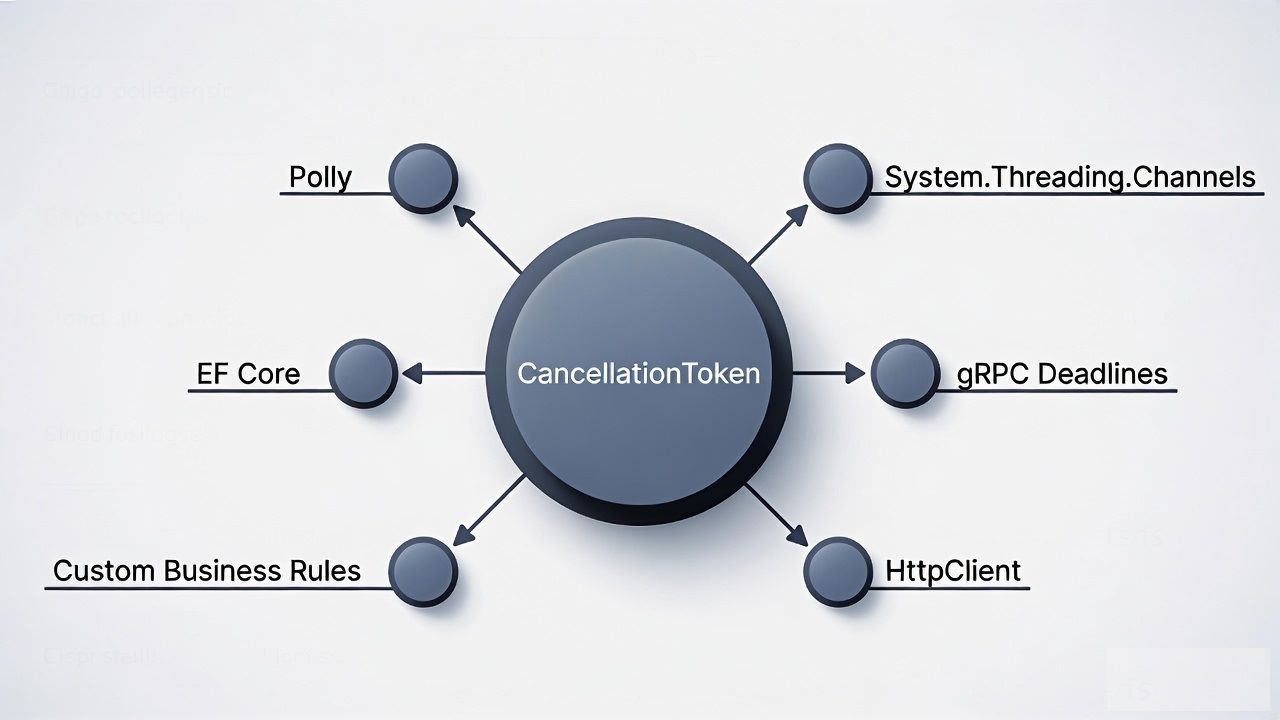
For complex distributed systems, this keeps latency and resource usage under control.
10. Conclusion: The ROI of Proactive Cancellation
CancellationToken is not a nice-to-have optimisation you add
when performance becomes a problem. It is a fundamental contract of async
programming in .NET. Every async method that doesn’t accept one is a
potential resource leak waiting to manifest under load.
The returns are tangible: teams that retrofit proper cancellation support
into existing APIs consistently report
20–50% improvements in throughput under load, alongside
measurable reductions in database connection pool pressure and garbage
collection pauses. The investment is relatively small—a parameter here, a
.WithCancellation() call there—but the compounding effect
across a large codebase is significant.
Looking ahead, .NET 9+ continue to invest in structured concurrency patterns that make cooperative cancellation even more natural and less error-prone. The direction of the platform is clear: cancellation is central, not optional.
Your call to action: Open your codebase today. Search for
async Task methods that don’t accept a
CancellationToken. Start at the outermost layer—your
controllers—and trace the token inward through services, repositories, and
infrastructure code. Every gap you close is a resource leak you’ve
permanently sealed.
A codebase where CancellationToken flows cleanly from request
to database is not just more efficient—it’s more honest about what it’s
actually doing.
Studies indicate that proper cancellation propagation in high‑load ASP.NET Core APIs can reduce infrastructure costs by 15–30% through lower thread pool usage and reduced database connection churn—making it one of the highest‑ROI async best practices available to .NET developers today.